Sunday, 1 October 2023

12% solution 'superhero' portfolio and 'moomoo' trading account - end SEP 2023 update

The "12% solution"" recommendation email from David Alan Carter for the end of September was for

60% SHY (or cash) + 40% JNK (or SHY or cash)

So I will liquidate the 12% solution portfolio holdings when the US market opens and move to cash for this month.

David Alan Carter's monthly "12% solution" update email reported the YTD performance for 2023 so far as being +16.1%.

Overall my 'superhero' trading account was down during September - from $2,162.41 to $2,056.81

My other 'moomoo' trading app account (where I try to read the entrails of technical charts to make profitable 'long' positions on the index trading VAS ETF) managed to be slightly up during September despite VAS and the markets being down - from $5,179.63 to $5,200.38. This month the movement was entirely due to my trading performance. My overall trading result is now a 43% win:loss ratio, with four stop-loss trades losing an average of $61.53 per trade, and three take-profit trades gaining an average of $84.87 each. The win:loss ratio is still quite good (but still way too early to draw any conclusions), and the average realized losses moved closer to the planned (-$50) target, and the winning trades getting closer to the planned ($100) target. 

Compared to the 'benchmark' of the S&P500 index my 'trading' was quite successful during September. My overall yield is +2.03% while the S&P 500 during the same period is -6.41%. The 'plan' is to open a long position when the market seems to be in the early stages of an upward trend, and take a profit (or roll-over the position and reset stop-loss and take-profit alert settings if the trend is holding) when the price target is reached, or close out when the stop-loss is reached. Setting the take-profit to be a 1% gain while the stop-loss is set at a -0.5% loss, should result in profitable trading *if* I have winning trades close to 50% of the time. Of course, the take-profit trigger being twice the stop-loss trigger as a percentage change means that the stop-loss would be triggered more often than the take=profit trigger, if my reading of the trading entrails doesn't avoid opening positions when the market is about to start dropping. We'll see how things play out over coming months.


Subscribe to Enough Wealth. Copyright 2006-2023

Friday, 22 September 2023

Rental investment property blues

Apparently the tenants for my rental apartment have not paid the rent since 24 August, so the managing agent issued a termination notice with termination date 22 Sep (today). If the tenants don't pay the rent that is due, or vacate (give possession), then an application will be lodged with the relevant government tribunal (costing $60) and the case will be addressed in a couple of weeks. We'll see what happens. The tenants could catch up on the owed rent, or could move out and hand the keys to the managing agent, or not do anything -- in which case the application will be heard in a few weeks' time. The tribunal might terminate the lease (in which case the tenants should leave -- but sometimes you have to get the local council 'sheriff' to notify them the move out of the premises). Or the tenants might claim difficulty paying the rent and seek some sort of 'arrangement' to slowly catch up on the owed rent -- which can then drag on for a long time (and the tenants eventually move out owing even more in unpaid rent). Or the tenants could pay the owed rent the day of the hearing, in which case the application is dismissed (and often the entire cycle of falling behind in rent repeats).

In my previous experience having a rental property, it is quite common for tenants to move out without notice when they are many weeks behind in the rent, leaving a mess that needs cleaning up, damage to be repaired, and a two week 'bond' that doesn't even cover the cost of repairs and cleaning, let alone the amount of unpaid rent that is owed. The tenants then often move interstate (or in this case possibly overseas) and you can never recover the owed rent. Then you often have the property vacant for another couple of weeks while looking for new tenants (and paying for advertising etc).

One has to take the 'long view' with such things - otherwise you worry about having to make mortgage intereest payments on a $1MM mortgage at 6.29% while not getting any rental income, and also having to pay strata levy, insurance, council rates, utilities etc.

In the 'long run' rental income should cover *most* (or a large part) of the holding costs, the net negative cashflow and depreciation should provide some tax relief, and the eventual capital appreciation (after paying capital gains tax) *should* make the investment profitable in the long run.

ps. My application for income tax variation (based on the expected net loss from the investment property this financial year) was approved in August, but had not been applied by my employer's payroll department as of last week -- so I had to check with the ATO that the variation approval had been sent to my employer (it had) and then try to contact the payroll department (in HR) to find out why my withholding tax had not been varied yet. I still haven't received an update regarding the 'ticket' I had to lodge (other than an automatic response that it had been received), so I have no idea when my take home pay will start to reflect the reduced withholding tax rate of 11% for the remainder of this financial year.

Subscribe to Enough Wealth. Copyright 2006-2023

Thursday, 21 September 2023

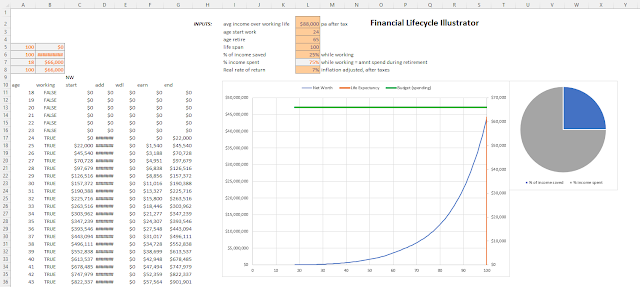
Simple Financial Lifecycle Illustrator

A Simple Financial Lifecycle Illustrator that you can play around with.

All figures are in current $ terms.

Enter the average after tax (take home) salary, age start and end full time employment, percentage of salary saved. It is assumed that all savings are available for retirement income, and that the amount of take home - savings = budget (both while working and during retirement). Then enter the inflation-adjusted after-tax rate of return (eg. If invested in index stock funds within superannuation, where the tax rate is 15% and the inflation rate was 2%, then an average return of 11% becomes 9% after adjusting for inflation, and 7.65% after tax).

Playing around with it lets you see the impact of changes to savings rate, retirement age, asset allocation (ie expected average return) and so on. It is a very simplistic model, as assumes the entered values are the average for the entire timeframe and doesn't allow for sequencing risk of any variability, periods spent working part-time etc.


Subscribe to Enough Wealth. Copyright 2006-2023

Friday, 8 September 2023

Transition to retirement plans

I currently plan on sticking with my current full-time employment (barring any serious health issues or being made redundant) for another 8 years or so -- which would bring me to age 70. When I turn 65 I will be able to transfer my SMSF accumulation account balance into 'pension phase', which will mean (under current tax law) that the earnings and capital gains be taxed within the SMSF at 0% rather than the normal 15% tax rate on earnings (and 10% on capital gains). Based on my current SMSF balance, 10% SGL contributions and roughly 6% real rate of return, I should be close to the TBC (transfer balance cap) of $1.9MM at age 65. I might use $100,000 or so of the TBC at age 65 to purchase a deferred lifetime annuity to commence payments from age 85 -- which should provide an annual inflation-adjusted income of about $21,500 pa from age 85 onwards (which would cover around half of my budgeted living expenses). This should be sufficient to ensure I have sufficient retirement income even if sequencing risks adversely affects my SMSF balance (e.g. if there is a major market crash just after I retire and switch from making contributions to making withdrawals).

The mandatory minimum drawdown rate from an SABP (Simple Account Based Pension) for someone aged 65-74 is 5% pa, so a $1.9MM account balance in pension phase would require $95,000 tax exempt pension payment to initially be made each year. As I plan to be still working FT to age 70, the entire pension income can be used to quickly pay down the balance on my investment apartment loan while I am still working (and working on my PhD).

The investment apartment should become cash flow positive after a few years of paying off the mortgage principle using my SMSF pension income.

Once I retire from FT employment I plan to continue working PT as a financial advisor for up to decade (depending on how I feel at the time). The SMSF pension should be sufficient to cover living expenses and pay off the remaining investment property loan fairly rapidly, so any additional income earned as a financial adviser when 'semi-retired' will be available for investment (probably into my investment bond).

Then when I eventually fully retire, my financial planning business *might* be able to be sold for around 3.5x annual revenue, but I can't really estimate what that might be, Once I completely stop work the SMSF pension should be considerably more than I require, so I will probably invest any surplus income. As the SMSF pension is tax exempt, I will be able to earn up to $45,000 pa from personal investments, rental income etc. and stay within the 19% tax bracket. The net rental income from the investment apartment probably won't be quite this much, so I can probably invest some amount in my own name, then, once the taxable income gets over $45,000, I will direct any surplus income into my Investment Bond account, where it is internally taxed at up to 30% (probably around 20% due to being invested in the tax optimised funds).

The SMSF balance should continue to grow as long as the minimum drawdown rate remains below 8% (the 9% withdrawal rate kicks in at age 85), after which the pension payments will have increased to an extent that it starts to erode my SMSF account balance. The increasing surplus of pension payment compared to my budgeted living expenses (around $40,,000 pa) will be invested in the Investment Bond (and can be withdrawn tax free at any time if I require some additional income during retirement).

I doubt that my SMSF balance will be depleted during my lifetime (longevity risk), but in any case my existing deferred lifetime annuity will commence making pension payments of about $40,000pa (indexed to inflation) from age 99 onwards, so I won't have any financial concerns if I happen to live as long as my great Aunt (who made it to 104).

I did a rough calculation of how my NW has tracked over the past 20 years or so, adjusting the monthly figures to constant 2022 $ terms using the RBAs annual cpi index data, and also adding in the 'deflated' value of the lake house property I was given in 2014 for the prior year figures. I have been savings/investing around $25K pa over this period, and using an average rate of return (after tax) of 6% produces a 'projection' curve that tracks pretty closely to my actual NW. Based on this I should have around $10MM NW by the time I fully retire, and as the required retirement income will be negligible ($40K pa is only 0.4% of $10MM) my NW should continue to grow somewhat in line with this 'projection' even during my retirement. Of course any prediction extrapolating several decades into the future is likely to be nowhere close to reality.


Subscribe to Enough Wealth. Copyright 2006-2023