Sunday, 26 February 2023

Million dollar mortgage

The purchase of my off-the-plan investment unit finally settled last Friday. I had paid $100,000 deposit back in 2019, plus $41,000 stamp duty, so the balance of $900,000 was due upon settlement. However, the residential mortgage approval required I pay off and close down some of my existing credit cards and lines of credit, plus our existing $37,000 home mortgage had to be paid off and also the $90,000 or so owing on 'portfolio loans' against our home equity. The balance of the investment unit purchase price and our remaining home loan and most of the portfolio loan were paid off using the new $1 million residential mortgage, and I also had to transfer $40,000 into the bank account that will be used for the monthly mortgage payment direct debits and which was also used to pay off any part of the portfolio loan balance that couldn't be covered by the new residential mortgage. Around $31,000 was taken from that account for settlement, which probably also included a few thousand in bank loan fees, valuation fees, title transfer fees, adjustments relating to pre-paid or owing rates, land taxes, insurances etc.

The opening balance of my 'million dollar mortgage' is shown below - quite an impressive round number in terms of debt IMHO. Next step is to collect the 'settlement box' which will contain the unit keys etc. on Monday morning, do a quick check of the apartment (I think the balcony railing needed a final wipe over), and then I'll hand the apartment keys to the managing agent to show the unit to prospective tenants. Hopefully it won't take too long to find a tenant, and the rental ends up being somewhere in the estimated $700-$750 per week range ($3,000 per month). Given that the monthly mortgage payment is $4,705 and that there will be other outgoings deducted from the rent income, I hope the unit doesn't have extended period of vacancy.


Subscribe to Enough Wealth. Copyright 2006-2023

Sunday, 12 February 2023

Astrophotography - attempt 3 - comet E3 conjunction with Mars

I had planned to drive out to a nearby 'dark' sky site (slightly less light pollution than where I live), but due to intermittent cloud cover I decided to just wait at home and when there seemed to be a break in the cloud cover I took 180x3 second exposures )using my 55-200mm zoom lens at 55mm, F/4, ISO 12,800) from my front balcony, with the camera in a corner where the glare from a nearby street lamp was blocked from directly hitting the lens. I also took 50 'dark' frames (3 sec with lens cap on) and 50 'flat' frames (using some white cloth in front of the lens illuminated using my tablet, and Automatic exposure length), and had planned to take 50 'bias' frames (1/4,000 sec exposures) but the SD card was full after taking 34 bias frames. There was still probably some light cloud cover passing overhead, but none of the lights showed obvious cloud cover, so I didn't discard any of the images from the stacking process. A car also drove past and turned on a floodlight across the street, so I expected 4-5 of the lights would be ruined, but I couldn't see any obvious problem images (although the final result could probably be improved by eliminating some of the light frames that were affected by cloud cover or the car/floodlight glare -- but I'd need to run through the pre-processing manually to do that).

I did automatic pre-processing using the standard script in SiriL, and then saved the resulting image as a jpg and did some rudimentary brightness and contrast tweaking in GIMP (although I don't really know what I doing and just played around with some settings).

At least in my 'final' image you can tell the comet E3 is in close conjunction with Mars, so I'm happy enough with the result. At least I managed to get the stars reasonably in focus this time! Usually with exposures taken over a period of around 10 minutes the comet would have moved compared to the star field, so some fancy processing to register and stack the stars and then separately register and stack the comet with the stars removed from the image would be required. But there doesn't seem to be too much movement/blurring of the comet in my final image - not sure if it is because the comet is now on the way out from the sun and its apparent angular motion has reduced already, or just due to the relatively short total time period during which the lights were taken.

Anyhow, I took my first astrophotograph of a comet, and the result is at least recognizeable. So I'm happy.


Subscribe to Enough Wealth. Copyright 2006-2023

Thursday, 2 February 2023

Net Worth Jan 2023

My monthly NW estimate has been updated in NetWorthShare for the end of January. Chart is in the side-bar.

My 'Stocks' figure was down -$330 (-0.11%) to $289,243 net equity The Australia and US markets were both higher during January, but in AUD terms the rise in the AUD vs USD meant the value of my 'portfolio' in AUD was flat. It is also distorted by the fact that I don't have many stock/fund investments remaining outside of super, and that for historic reasons I include the deposit and stamp duty I paid in 2019 for the investment apartment in this figure. Once 'settlement' happens (in the next week or two) I will remove this from the 'stocks' figure and include it the 'other real estate' and 'other mortgages' figures.

The value of my 'Other Assets' category (gold and silver proof coin collection, valued at bullion value only, Perth Mint unallocated gold, silver and platinum holdings, and my small art investment via Masterworks) was up slightly during January, rising $246 (0.74%) to $33,363.

Our estimated house price for January (my half) fell another $18,137 (-1.67%) to  $1,067,538 with continued weakness in the Sydney real estate market due to rising interest rates. The RBA has recently indicated that they believe inflation peaked at the end of 2022, which *might* reduce the likelihood of further interest rate rises. There are also a lot of homeowners with fixed interest rates due to revert to variable rates during 2023, which will magnify the impact of the mortgage interest rate increases that already occurred during 2022. So real estate prices could continue to be subdued during 2023, but the cycle of mortgage interest rate increases may soon end.

The value of my retirement savings increased to $1,481,706 (up $70,779 or +5.02%) during January. The $10K I transferred from one of my superannuation accounts to purchase a deferred lifetime annuity is still counted as part of the overall superannuation balance, although it won't commence providing an income stream until 2061 (if I am still alive).

Overall, my estimated NW increased to $3,183,910 during the past month - up by $52,806 (+1.69%). The valuation for the investment apartment the bank obtained during loan approval came in very low ($750K), which is a lot lower than the price ($1MM) or a recent sale for a similar unit ($1.4MM). I suspect the valuation was done based on 'similar sales' of 1-bedroom units in the suburb, which wouldn't be accurate as the suburb has a lot of 'older low rise' apartment blocks which would have different pricing compared to the latest new developments (which are 'high rise' luxury apartment complexes). So, I'll just continue to use the 'cost price' in my NW estimates until there are more 'similar sales' occurring in the suburb, so the median 1 and 2 bedroom apartment prices start to reflect the inclusion of these new developments.

Subscribe to Enough Wealth. Copyright 2006-2023

Friday, 27 January 2023

Astrophotography - attempt 2

There were a few hours of clear skies on the evening of 25/26 Jan, so I did another session. My initial attempt to block out the street lamp flare by using the lens hood didn't work - test exposures showed a nicely illuminated 'circle' around the outside of the image -- with the lens hood encroaching into the FOV and being well lit by the street lamp. I think the lens hood must be meant for use with my 50-200 mm zoom lens rather than the 18-55 mm zoom lens.

So I removed the lens hood and relocated from the front porch the our back yard, where our house and boundary fencing block out all direct illumination from street lights and the neighbouring houses (can't do much about the Bortle 5 sky darkness in my back garden. Driving 15 minutes to a nearby national park provides a slight reduction in light pollution (Bortle 4) which will be helpful to try and image the E3 comet on 11 Feb. If I drive 3.5 hours to my hobby farm/lake house I have access to a 'dark sky' which is Bortle 2. The best dark sky site I could access is at Coonabarabran, close to the Anglo-Australian Telescope (AAT) at Siding Spring Observatory -- unfortunately that is a 6 hour drive from Sydney!). Orion was getting low by the time the skies had cleared, so I simply aimed at a patch of sky above Orion. Unfortunately having the camera pointed more towards the zenith made it a bit awkward to check the focus after each test shot, and my homemade Bahdinov mask (cut from some paper and cardboard) didn't seem to work very well, so after ten minutes I gave up and simply turned the focus ring all the way over to 'infinitiy'. Big mistake. Especially as I didn't bother taking another test exposure to check the focus, but simply cleared the SD card and commenced taking a series of lights, darks, biases and flats.

I took 11 sets of 9 x 3 second exposures at F/5,5, 55mm FL and ISO 12,800. The sets of 9 exposures were due to the D3300 self-timer mode only supporting up to 9 shots in a sequence. You then have to press the shutter button again for another set of 9 shots (after the initial delay of 5 seconds I had set to minimize camera shake from pressing the shutter button). I also had to reset the self-timer mode after each set as the camera display shut down after a few seconds and reverted to single exposure mode. I could probably fiddle with the shut-down delay setting to avoid having to reset the self-timer setting after each series, but that might cause an issue with battery life (the fully charge battery lasted for two nights - about 3 hours of camera use - before needing to be recharged).

I had also worked out how to get properly exposed 'flats' using the 'A' mode (aperture priority) that kept all the manually setting unchanged, but worked out the correct exposure time. I used a piece of fine weave white cloth (a lot of people use a 'white T-shirt') over the lens and the 'light box' app on my tablet to provide a uniform illumination. The flats seemed OK (the automatic exposure time was 1/8th second) with the histogram being fairly central for the flat exposures.

I processed the lights, darks, biases, and flats using SiriL, and all went well until it got to the 'find stars' stage required to register (align) and stack the lights. The software reported the process failed, with '0 stars found' - which is due to my lights being too out of focus. The software finds stars by finding the centroid of a star (a couple of illuminated pixels), and won't work if the image is too out of focus. Looking at a couple of my 'lights' the stars were totally out of focus and spread over dozens of pixels! I definitely should have taken a single test exposure and checked the focus was 'reasonable' before wating an hour taking exposures.

I've made two small purchases to improve future astrophotography sessions with my DSLR and tripod - I bought a commercially produced 'Bahdinov mask' for about $6 (it is being shipped from China, so probably won't arrive until the end of Feb -- well after I want to image Comet E3 around 11 Feb). I also ordered a cheap ($24) intervalometer from Amazon.com that will allow me to 'program' a series of exposures and then execute them with a single button press on the hand controller. This will allow me to execute an entire series of 100 or more 'lights' with a single button press, rather than having to use a series of 9 shots each individual started. Also, because I won't have to touch the camera at all during the series of exposures, I won't have to have a delay between each exposire -- so rather than a 3 second exposure being followed by a 2 second delay, I can just fire off a series of 3 second exposures one after the other -- reducing the overall time by around 40%. Once the 64 GB SD card on order has arrived (to replace the current 8GB SD card) I will also be able to increase the number of lights, darks, biases and flats from 99/54/45/45 to 300/100/50/50 - which should improve the signal to noise ratio and bias compensation. There isn't another clear night predicted for a week or more, so hopefully my SD card (and possibly the intervalometer) will have arrived before my next imaging session.
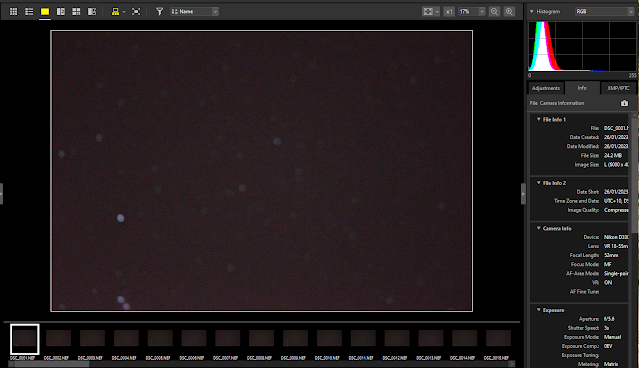
How to waste an hour by not checking focus before taking a series of 99 3-second exposures. D'Oh!

Subscribe to Enough Wealth. Copyright 2006-2023